INFORMATION
Jflabel-Professional Custom Thermal Paper Rolls Manufacturer Over Years.
Language
Blue architectural and engineering drawings emerged as a mass drawing-making method in the era before computer-aided drawing was available.
Drafters would draw designs on a type of transparent paper called tracing paper with carbon pens. This was to facilitate the mass production of identical drawings using blueprint machines when a large quantity of drawings was needed for subsequent use.
The blue color on the drawings stems from the light-sensitive fixing principle of blueprint machines that utilizes ammonia water, and it carries no other special meaning.
Nowadays, drafters no longer need to create drawings by hand; instead, they use Computer-Aided Design (CAD) to complete all types of structural drawings. When plotting the drawings, large plotters similar to printers can be used to print the digital designs from computers onto white paper, or in color as needed.
Nevertheless, designers still adhere to the traditional blueprinting method for mass replicating the same drawing. This method features extremely low production costs: the cost of blueprinting an A1-sized drawing is approximately 0.80 RMB. It also offers high efficiency, with an A1-sized drawing taking only a few seconds to be blueprint printed.
To make a blueprint less blue, the exposure time during the blueprinting process can be extended; conversely, shortening the exposure time will result in a deeper blue hue.
Blueprint paper, also referred to as blueprinting paper, positive diazonium blueprint paper or diazonium photosensitive paper, is a roll-form processed paper manufactured by coating a photosensitive agent onto blueprint base paper which serves as its substrate.
The base paper is required to have excellent wet tensile strength and absorbency, minimal wet deformation, and be free of any chemicals that may impair the performance of photosensitive materials. It is typically made from cotton pulp or bleached wood pulp on a paper machine. Qualified base paper produces blueprint paper with a smooth surface, an evenly coated photosensitive layer, and no white spots, blemishes, chemical stains or creases.
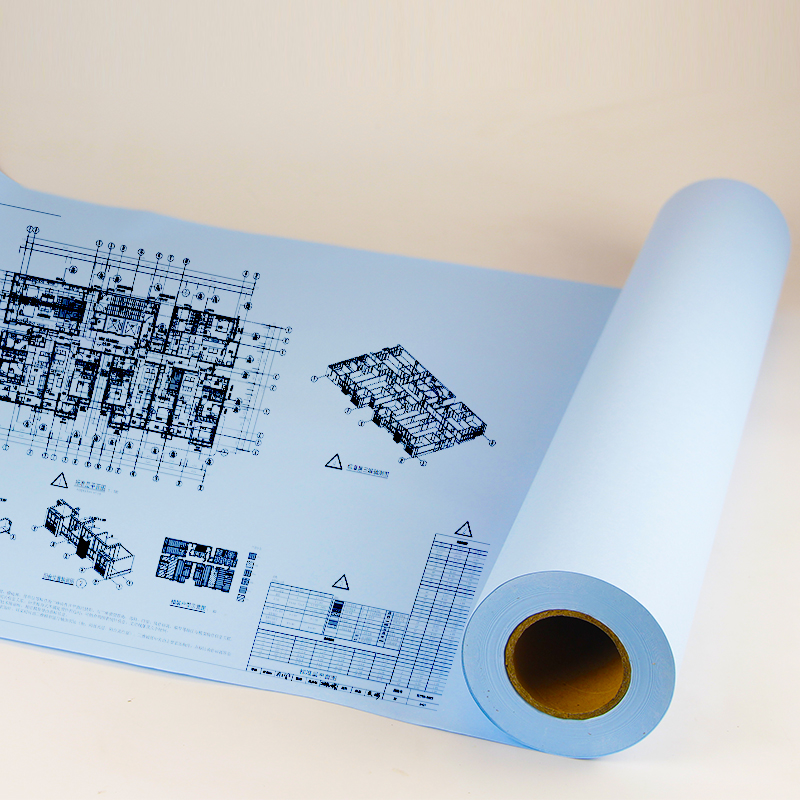
Blueprint paper is classified by its application method into the following types:
1.Wet-process blueprint paper, also known as water-washed blueprint paper or iron salt blueprint paper. Its photosensitive reduction is achieved through water washing, and this method is still in use by a small number of institutions.
2.Dry-process blueprint paper, also called diazonium coupling blueprint paper or ammonia-fumigated blueprint paper. Its photosensitive reduction is realized with ammonia gas, and this is the only type of blueprint paper supplied in the domestic market.
3.Semi-wet-process blueprint paper includes two variants: one has both photosensitive and reducing agents coated on the paper, forming images through coupling during exposure – this type is not yet available in China; the other is adapted for dry-process blueprinting, where ammonia water is vaporized into mist during the process to form images simultaneously with exposure.
Classified by the color of its lines, blueprint paper falls into these categories:
1.Blue lines on white background, white lines on blue background, and brown lines on white background – these belong to wet-process blueprint paper.
2.Purple lines on blue background, brown lines on white background, and black lines on white background – these are dry-process blueprint paper. At present, purple lines on a blue background are the most common type in China, with blue or black lines on a white background available in a few individual regions.
As one of the experienced thermal paper rolls suppliers, Jflabel have a professional design team with 20 years of production experience. From publishing, printing and cutting to finished packaging, we provide customers with a full range of services!